Louisville Emergency Roofing Service Areas

Comprehensive emergency storm damage, hail inspection, and roofing triage dispatch directory covering Jefferson County and the Ohio River corridor.
Roof Expert USA provides 24/7 emergency storm damage triage and independent roofing contractor dispatch across Louisville, Jefferson County, Oldham County, and the greater Ohio River metropolitan region. Whether your residential roof in Prospect suffered river-bluff wind shear, your commercial flat roof in Jeffersontown has severe ponding, or heavy oak limbs punctured roof decking in St. Matthews, our referral network connects you with vetted, licensed local roofing specialists ready for immediate emergency stabilization.

Regional Ohio River Dispatch Coverage

The Louisville metropolitan region occupies a unique geographic basin along the Ohio River, creating intense localized microclimates. Convective supercell storms pushing eastward across Indiana regularly intensify as they hit the river valley, generating high-velocity downbursts, large hail swarms, and torrential cloudbursts. Dispatched roofing contractors maintain fully equipped service vehicles throughout the primary coverage corridors to ensure rapid dispatch across all communities.

Featured Regional Suburb Coverage

Oldham / Jefferson County

Prospect Roof Repair

High-elevation river bluff properties face intense wind shear and directional hail storms. Specializing in luxury slate, architectural shingles, and heavy cedar shake restorations.

Prospect Dispatch Details →
East Louisville Commercial & Residential

Jeffersontown Storm Damage

Suburban residential subdivisions and Bluegrass Commerce Park commercial roofs. Rapid dispatch for shingle blowouts, flat roof membrane punctures, and drainage sumps.

Jeffersontown Dispatch Details →
Historic Canopy & Residential

St. Matthews Roof Tarping

Mature tree canopies in St. Matthews lead to frequent tree limb deck punctures during severe wind events. Emergency 10-mil poly timber-batten tarping and rafter shoring.

St. Matthews Dispatch Details →
Eastern Jefferson Corridor

Middletown Roof Leak

High-volume residential subdivisions with complex multi-valley roof profiles. Triage for active ceiling leaks, cracked plumbing pipe boots, and winter ice dam backups.

Middletown Dispatch Details →

Cross-River & Regional Metro Service Scope

In addition to primary Jefferson County hubs, Roof Expert USA's dispatch desk coordinates emergency service across the broader Ohio River basin, including:

  • Louisville Urban Core: Downtown, Old Louisville, The Highlands, Clifton, Butchertown, and Crescent Hill (specializing in historic brick masonry chimney flashing and flat porch roofs).
  • Southern & Western Jefferson County: Shively, Pleasure Ridge Park (PRP), Valley Station, and Fairdale.
  • East End Enclaves: Anchorage, Indian Hills, Glenview, Mockingbird Valley, and Northfield.
  • Southern Indiana Metro Border: Clarksville, IN and New Albany, IN cross-river coordination.

Frequently Asked Questions

What areas around Louisville do your dispatched contractors cover? +

Dispatched independent roofing contractors cover all of Louisville and Jefferson County, including Prospect, Jeffersontown, St. Matthews, Middletown, Anchorage, as well as Oldham County and Southern Indiana border communities.

How quickly can emergency tarping crews arrive at suburban locations? +

Depending on severe storm traffic and weather road conditions, on-call contractors typically reach suburban locations in Prospect, Jeffersontown, St. Matthews, and Middletown within 60 to 120 minutes of dispatch confirmation.

Does RoofExpertUSA charge homeowners for dispatching contractors? +

No. RoofExpertUSA operates as a free referral and emergency intake service for property owners. All project estimates, diagnostic fees (if applicable), and contractual scopes are agreed upon directly between the homeowner and the independent contractor.

Jefferson County & Ohio River Valley Technical Engineering

Ohio River Storm Dynamics & Structural Roof Mitigation Protocols

The geography of the Ohio River basin creates severe convective weather corridors across Louisville, Southern Indiana, and Jefferson County. Understanding these technical dynamics prevents recurring structural water damage.

1. Ohio River Wind Corridors & Convective Hail Microclimates

Louisville occupies a low-elevation river basin directly flanked by the Knobs region to the south and open Southern Indiana plains to the north. This geographic trough acts as an atmospheric wind funnel for severe mesoscale convective systems tracking eastward along the Ohio River. When unstable warm air masses collide with cold Canadian fronts over the river, severe supercells generate high-velocity straight-line winds exceeding 70 to 80 miles per hour, accompanied by high-density hail swaths.

These severe wind shears create intense negative aerodynamic pressure along windward roof eaves, rakes, and ridges. Shingles along perimeter starter courses lose adhesion as brittle sealant strips snap under aerodynamic suction. Compounding wind stress, golf-ball-sized hail stones driven by horizontal gusts crush fiberglass reinforcement mats in architectural shingles, fracturing underlying asphalt and dislodging mineral granules across thousands of square feet of roof decking.

2. Non-Destructive Moisture Tracing & FLIR Thermal Diagnostics

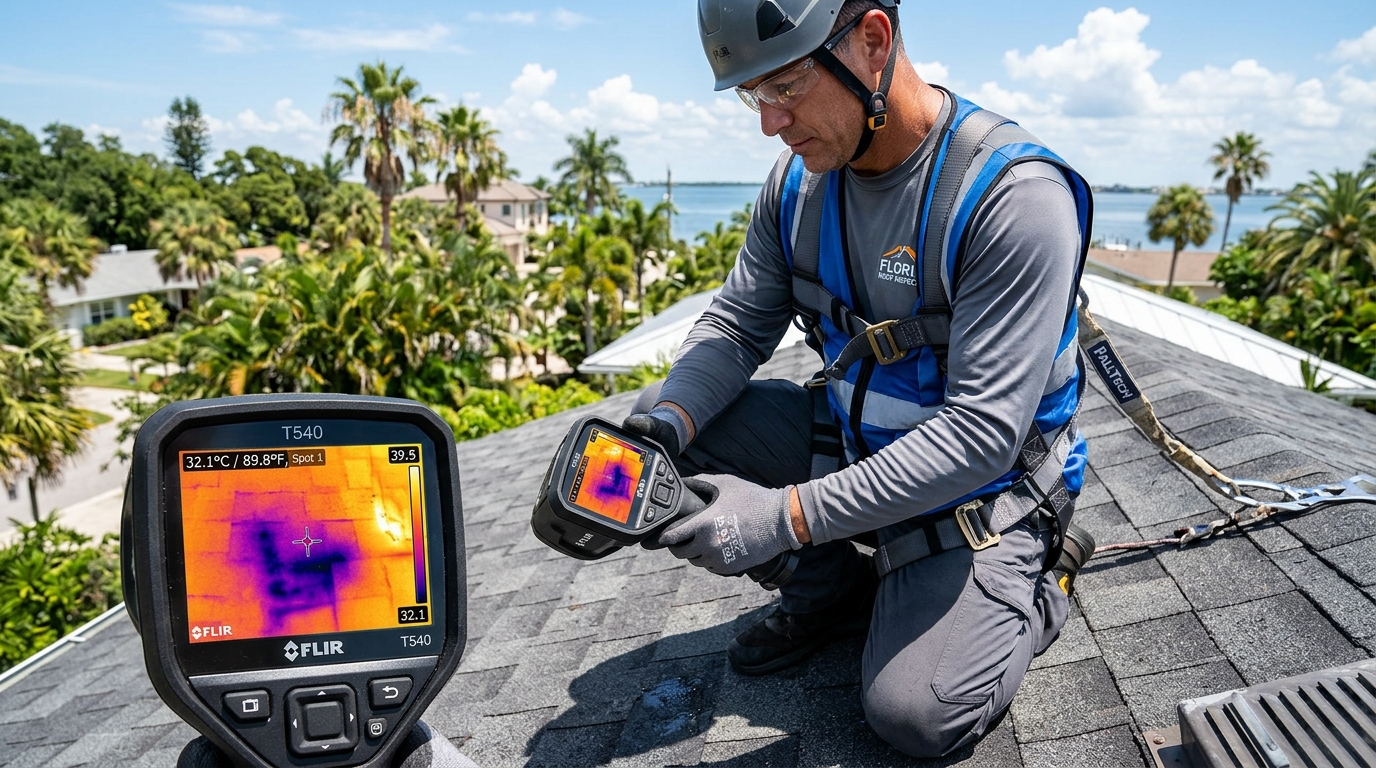
A frequent challenge during Louisville storm damage events is that water rarely drips into the living space directly below the exterior roof puncture. Rainwater penetrating a breached shingle lap, compromised chimney counterflashing, or damaged pipe boot travels along roof rafters, follows horizontal electrical wiring conduits, and pools on vapor barriers before finding an opening in ceiling drywall.

Contractors dispatched through our referral network utilize professional FLIR (Forward Looking Infrared) thermographic cameras and electronic moisture pin meters. Because wet insulation materials retain cooler thermal mass during daytime warming and warmer mass during nocturnal cooling, high-resolution infrared imaging reveals the exact subterranean migration path of water. This enables technicians to target exterior repairs with pinpoint accuracy without performing unnecessary exploratory demolition on interior ceilings.

3. Step-by-Step Deck Restoration & Elastomeric Sealing

When wind or falling hardwood limbs breach roof sheathing, proper restoration requires structured mechanical engineering rather than surface mastic patching. Dispatched contractors execute a disciplined multi-stage protocol:

  • Substrate Extraction: Compromised, water-saturated, or delaminated OSB/plywood sheathing is cleanly cut back to the center of adjacent load-bearing rafters.
  • Framing Reinforcement: Rafter chords are inspected for deflection or fracture and reinforced with sister framing lumber where necessary.
  • Structural Sheathing Replacement: New CDX exterior-grade plywood or OSB matching the original deck thickness is securely fastened using 8d ring-shank nails spaced at 6 inches on center along edges.
  • Self-Adhering Membrane Shield: A continuous layer of polymer-modified bitumen ice-and-water shield is rolled across the repaired deck, self-sealing around all mechanical fastener penetrations.
  • Interlocking Shingle Re-Integration: High-wind Class 4 impact architectural shingles matching the existing slope are interwoven with surrounding courses, hand-sealed with commercial-grade elastomeric asphalt cement.

4. Kentucky Building Code & Contractor Licensing Compliance

Permanent residential and commercial roofing restorations throughout Louisville and Jefferson County must strictly comply with the adopted Kentucky Residential Code (KRC) and Louisville Metro Department of Codes & Regulations standards. Key provisions dictate that all replacement shingles must achieve minimum ASTM D3161 Class F or ASTM D7158 Class H wind uplift ratings, ensuring resistance against 110 to 130 mph gusts.

Furthermore, state and local regulations require approved ice barrier membranes along all eaves, valleys, and wall intersections extending at least 24 inches inside the interior heated wall line. Independent roofing contractors in our referral network maintain active registration with the Kentucky Secretary of State, carry comprehensive general liability and workers' compensation coverage, and coordinate required local municipal building permits for structural re-decking.

5. Preventative Storm Preparedness & Winter Ice Dam Defense

Preserving roof longevity across Jefferson County requires proactive inspection routines before the onset of spring severe convective storm cycles and winter freeze-thaw periods. Louisville property owners should conduct bi-annual ground-level binocular audits:

  • Overhanging Canopy Clearance: Mature oak, sycamore, and maple branches within 10 feet of roof planes must be pruned back to eliminate branch impact punctures during sudden Ohio River squalls.
  • Penetration Collar Inspection: Inspect rubber plumbing boot flashings; intense summer UV exposure degrades neoprene within 6 to 8 years, creating hairline cracks that leak during high-intensity rain.
  • Masonry Chimney Reglet Integrity: Check chimney counterflashing mortar grooves; freeze-thaw cycles common in Kentucky winters pop mortar seals, allowing driving rain behind step flashings.
  • Valley Ice Dam Prevention: Clear leaf accumulation in valleys and install heating cables or self-adhering membranes to prevent freeze-thaw meltwater from backing up beneath shingles during Ohio Valley winter snowstorms.
CALL NOW — (888) 208‑4155