Emergency Roof Tarping Louisville KY

Heavy-duty 10-mil poly tarping with perimeter timber battens, rafter anchor screws, ridge wraps, and immediate storm barrier protection across Louisville and Jefferson County.
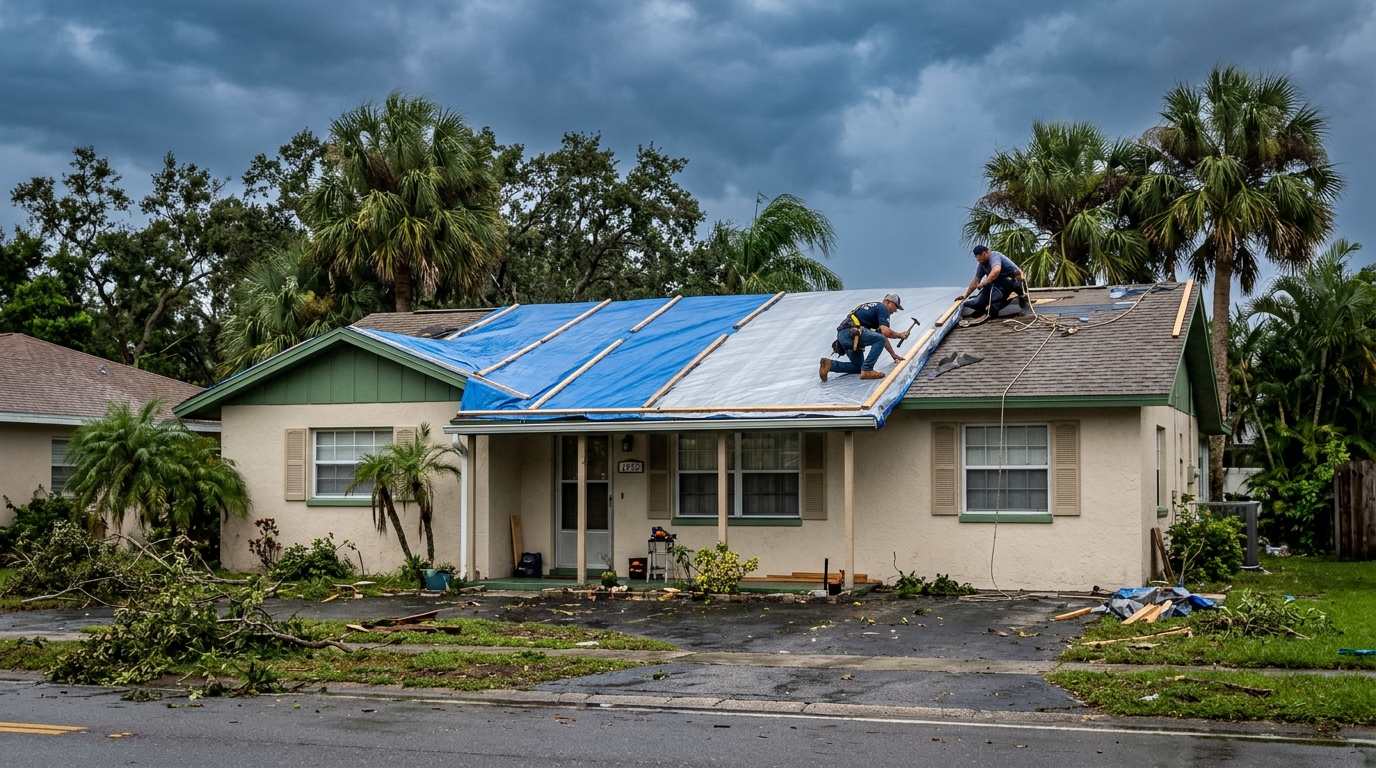
When severe Ohio River convective squalls, fallen hardwood oak branches, or tornado-force winds breach residential roofing structures in Louisville, exposed attic interiors face immediate water saturation. Substandard amateur tarping using thin plastic and bricks invariably tears loose during secondary gusts, creating thousands of dollars in secondary structural damage. Roof Expert USA coordinates 24/7 heavy-duty emergency roof tarping dispatch across Louisville and Jefferson County, utilizing engineered 10-mil woven poly membranes, timber battens, and rafter anchor screws.

Engineering Specialty: Post-Storm Timber-Batten Securing

Standard consumer tarps held down by rocks, sandbags, or unsealed staples fail during subsequent storm squalls because negative pressure creates powerful aerodynamic suction. When wind gusts enter beneath an unsecured tarp edge, they inflate the membrane like a parachute, tearing loose fasteners and violently ripping shingles off the deck.

Post-storm timber-batten securing provides an engineered, storm-resistant seal. Dispatched professional crews utilize heavy-duty 10-mil woven polyethylene tarps with UV coatings. The tarp edges are wrapped twice around kiln-dried 2x4 dimensional spruce lumber battens. These timber battens are mechanically fastened directly through the shingle courses into structural rafters using 3.5-inch coated framing screws with neoprene washers. The upper boundary is pulled smoothly over the roof ridge cap to prevent water running under the top seam. This creates an airtight, watertight structural shield capable of withstanding 65+ mph wind gusts until permanent rebuilds are permitted.

Engineered Tarping & Stabilization Standards

Tree Limb Puncture Shoring

When heavy fallen oak or maple branches puncture roof decking, crews safely remove branch debris, trim splintered OSB, and fasten 5/8-inch CDX plywood bridging over rafter voids prior to tarping.

Over-the-Ridge Continuous Wrapping

Technicians extend the upper edge of the tarp over the roof peak and secure it on the opposing leeward slope, ensuring driving rain cannot penetrate beneath the top horizontal seam.

Structural Rafter Screw Anchoring

Perimeter timber battens are screwed directly into structural roof rafters—not just flimsy plywood decking—to resist high negative-pressure uplift during secondary thunderstorm squalls.

Waterproof Underlayment Flashing

For complex valleys and dormers, self-adhering SBS modified bitumen membranes are layered under the tarp to seal irregular roof planes against water backflow.

Why Timber-Batten Tarping Is Critical for Insurance Claims

Under almost all Kentucky homeowner insurance policies, property owners have a strict legal duty to mitigate secondary damage following a storm loss. If a property owner leaves a breached roof open to subsequent rain, insurance adjusters may deny claims for secondary interior drywall, flooring, and mold damage. Professional timber-batten tarping provides verifiable proof of timely mitigation, complete with date-stamped contractor documentation for your adjuster.

Frequently Asked Questions

How long does a professional timber-batten roof tarp last? +

A properly installed 10-mil poly tarp secured with double-wrapped 2x4 lumber battens and rafter screws can reliably protect a home for 60 to 90 days, providing ample time for insurance adjustment, material procurement, and permanent replacement.

Will emergency tarping damage my existing shingles? +

Professional roofers place timber battens strategically to minimize shingle damage, fastening directly into structural rafters and sealing screw penetrations. Any minor fastener holes are incorporated into the permanent repair scope.

Is emergency roof tarping covered by homeowner insurance in Kentucky? +

Yes. Emergency mitigation services, including timber-batten roof tarping, tree debris removal, and dry-in stabilization, are typically 100% reimbursable under the emergency mitigation clause of standard homeowner insurance policies.

Jefferson County & Ohio River Valley Technical Engineering

Ohio River Storm Dynamics & Structural Roof Mitigation Protocols

The geography of the Ohio River basin creates severe convective weather corridors across Louisville, Southern Indiana, and Jefferson County. Understanding these technical dynamics prevents recurring structural water damage.

1. Ohio River Wind Corridors & Convective Hail Microclimates

Louisville occupies a low-elevation river basin directly flanked by the Knobs region to the south and open Southern Indiana plains to the north. This geographic trough acts as an atmospheric wind funnel for severe mesoscale convective systems tracking eastward along the Ohio River. When unstable warm air masses collide with cold Canadian fronts over the river, severe supercells generate high-velocity straight-line winds exceeding 70 to 80 miles per hour, accompanied by high-density hail swaths.

These severe wind shears create intense negative aerodynamic pressure along windward roof eaves, rakes, and ridges. Shingles along perimeter starter courses lose adhesion as brittle sealant strips snap under aerodynamic suction. Compounding wind stress, golf-ball-sized hail stones driven by horizontal gusts crush fiberglass reinforcement mats in architectural shingles, fracturing underlying asphalt and dislodging mineral granules across thousands of square feet of roof decking.

2. Non-Destructive Moisture Tracing & FLIR Thermal Diagnostics

A frequent challenge during Louisville storm damage events is that water rarely drips into the living space directly below the exterior roof puncture. Rainwater penetrating a breached shingle lap, compromised chimney counterflashing, or damaged pipe boot travels along roof rafters, follows horizontal electrical wiring conduits, and pools on vapor barriers before finding an opening in ceiling drywall.

Contractors dispatched through our referral network utilize professional FLIR (Forward Looking Infrared) thermographic cameras and electronic moisture pin meters. Because wet insulation materials retain cooler thermal mass during daytime warming and warmer mass during nocturnal cooling, high-resolution infrared imaging reveals the exact subterranean migration path of water. This enables technicians to target exterior repairs with pinpoint accuracy without performing unnecessary exploratory demolition on interior ceilings.

3. Step-by-Step Deck Restoration & Elastomeric Sealing

When wind or falling hardwood limbs breach roof sheathing, proper restoration requires structured mechanical engineering rather than surface mastic patching. Dispatched contractors execute a disciplined multi-stage protocol:

  • Substrate Extraction: Compromised, water-saturated, or delaminated OSB/plywood sheathing is cleanly cut back to the center of adjacent load-bearing rafters.
  • Framing Reinforcement: Rafter chords are inspected for deflection or fracture and reinforced with sister framing lumber where necessary.
  • Structural Sheathing Replacement: New CDX exterior-grade plywood or OSB matching the original deck thickness is securely fastened using 8d ring-shank nails spaced at 6 inches on center along edges.
  • Self-Adhering Membrane Shield: A continuous layer of polymer-modified bitumen ice-and-water shield is rolled across the repaired deck, self-sealing around all mechanical fastener penetrations.
  • Interlocking Shingle Re-Integration: High-wind Class 4 impact architectural shingles matching the existing slope are interwoven with surrounding courses, hand-sealed with commercial-grade elastomeric asphalt cement.

4. Kentucky Building Code & Contractor Licensing Compliance

Permanent residential and commercial roofing restorations throughout Louisville and Jefferson County must strictly comply with the adopted Kentucky Residential Code (KRC) and Louisville Metro Department of Codes & Regulations standards. Key provisions dictate that all replacement shingles must achieve minimum ASTM D3161 Class F or ASTM D7158 Class H wind uplift ratings, ensuring resistance against 110 to 130 mph gusts.

Furthermore, state and local regulations require approved ice barrier membranes along all eaves, valleys, and wall intersections extending at least 24 inches inside the interior heated wall line. Independent roofing contractors in our referral network maintain active registration with the Kentucky Secretary of State, carry comprehensive general liability and workers' compensation coverage, and coordinate required local municipal building permits for structural re-decking.

5. Preventative Storm Preparedness & Winter Ice Dam Defense

Preserving roof longevity across Jefferson County requires proactive inspection routines before the onset of spring severe convective storm cycles and winter freeze-thaw periods. Louisville property owners should conduct bi-annual ground-level binocular audits:

  • Overhanging Canopy Clearance: Mature oak, sycamore, and maple branches within 10 feet of roof planes must be pruned back to eliminate branch impact punctures during sudden Ohio River squalls.
  • Penetration Collar Inspection: Inspect rubber plumbing boot flashings; intense summer UV exposure degrades neoprene within 6 to 8 years, creating hairline cracks that leak during high-intensity rain.
  • Masonry Chimney Reglet Integrity: Check chimney counterflashing mortar grooves; freeze-thaw cycles common in Kentucky winters pop mortar seals, allowing driving rain behind step flashings.
  • Valley Ice Dam Prevention: Clear leaf accumulation in valleys and install heating cables or self-adhering membranes to prevent freeze-thaw meltwater from backing up beneath shingles during Ohio Valley winter snowstorms.
CALL NOW — (888) 208‑4155