Commercial Flat Roof Ponding Repair Louisville KY
Commercial flat roof patching, TPO / EPDM seam hot-air welding, tapered polyisocyanurate drainage correction, scupper clearing, and ponding remediation across Louisville.
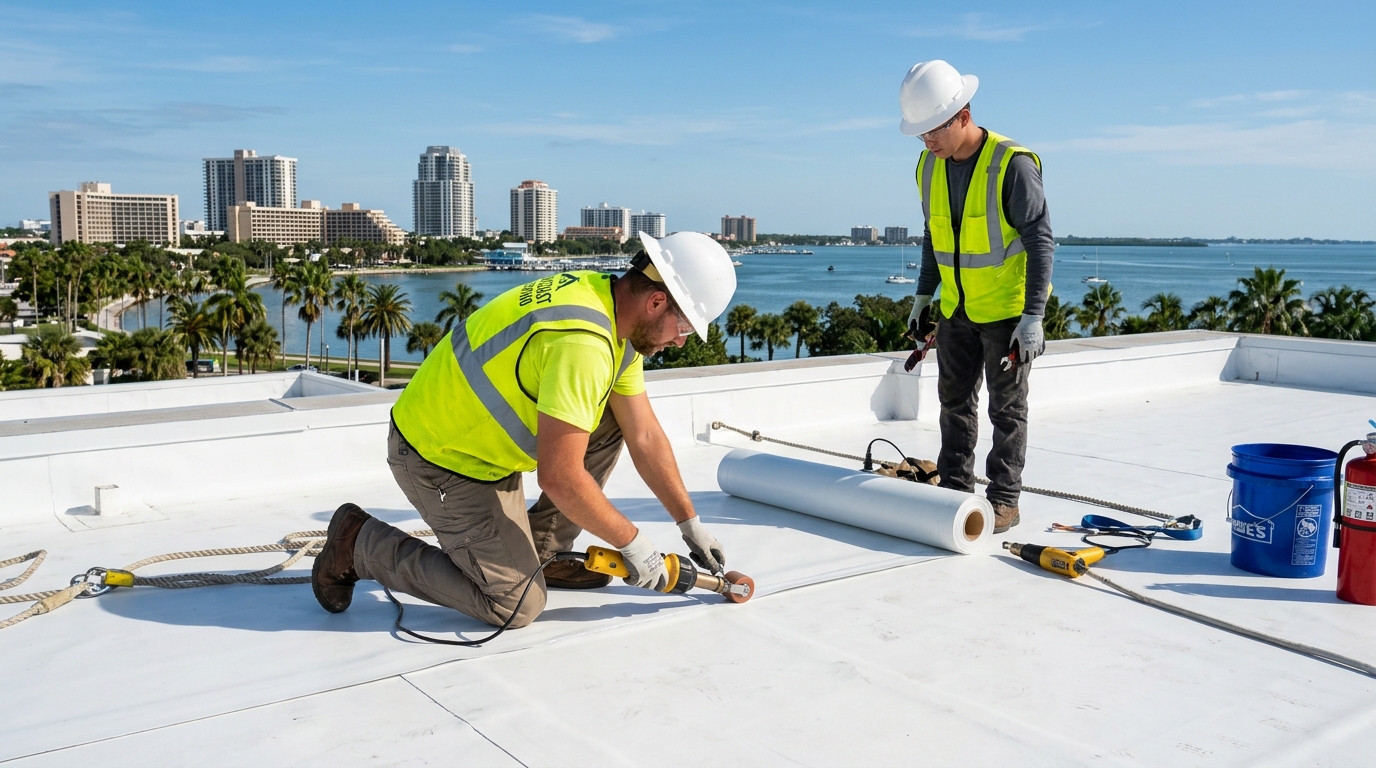
Commercial buildings, industrial facilities, and modern residential additions throughout Louisville face extreme moisture stresses from low-slope roof drainage challenges. Standing water on commercial flat roofs accelerates membrane deterioration, breaks down adhesive seams, and creates heavy dead-weight loads that deflect structural framing. Roof Expert USA operates an emergency low-slope dispatch desk connecting Louisville business owners and facility managers with commercial-grade flat roofing specialists equipped for hot-air seam welding, drainage correction, and membrane patching.
Engineering Specialty: Commercial Flat Roof Patch & Seam Welding
Under National Roofing Contractors Association (NRCA) standards, any water remaining on a low-slope roof surface 48 hours after rain has ended is classified as chronic ponding. Water is exceptionally heavy—weighing approximately 5.2 pounds per square foot for every single inch of depth. A 20-foot by 20-foot ponding area holding two inches of water adds more than two tons of dead load onto underlying joists and rafters.
Furthermore, standing water functions as a magnifying lens for summer solar rays, creating localized thermal pockets that bake thermoplastic polyolefin (TPO), EPDM rubber, and modified bitumen membranes. As organic debris settles into ponding basins, biological acids break down polymer chains, causing open seams and micro-fissures that allow moisture into rigid polyiso insulation boards. Dispatched commercial specialists perform commercial flat roof patch and hot-air seam welding: utilizing industrial Leister robotic welders operating at over 950°F to achieve monolithic molecular fusion on 60-mil TPO and PVC membranes, eliminating leaks permanently.
Advanced Low-Slope Membrane Restoration Technologies
Hot-Air Robotic Seam Welding (TPO/PVC)
Contractors clean delaminated TPO seams with specialized chemical solvents, probe seam strength with cotter keys, and fuse open laps using digital hot-air welders operating at over 900°F to achieve monolithic molecular bonding.
Modified Bitumen Torch & Cold Adhesive Repair
Technicians repair cracked or blistered SBS and APP modified bitumen sheets with reinforced mineral-surfaced cap sheets, embedded in high-solids elastomeric asphalt cement with 6-inch lap perimeters.
Tapered Polyiso Drainage Correction
To permanently eliminate ponding depressions, crews install tapered polyisocyanurate insulation sumps and crickets that slope water toward drains and through-wall scuppers at a minimum 1/4-inch per foot fall.
High-Solids Silicone Coating Systems
Application of fluid-applied 100% silicone coatings that remain completely impervious to permanent ponding water, offering seamless UV protection and dramatically reducing interior cooling costs.
Commercial & Residential Low-Slope Dispatch
Whether you manage a commercial warehouse near Louisville International Airport (SDF), a retail property in Downtown Louisville, or a modern residential home with a flat patio roof in The Highlands, our referral network connects you with vetted flat roofing specialists. Call (888) 208-4155 for immediate flat roof leak dispatch.
Frequently Asked Questions
What is considered severe ponding water on a flat roof? +
Any pool of standing water that fails to evaporate or drain within 48 hours following rain is classified as chronic ponding. This standing water violates manufacturer warranties and dramatically increases the risk of structural leak intrusion.
Can an old flat roof be restored without a costly tear-off? +
Yes. If the underlying insulation board is dry and structurally sound, high-solids silicone or elastomeric roof coating systems can be applied over existing TPO, EPDM, or modified bitumen membranes to restore watertight integrity and extend roof life by 10 to 20 years.
How do you locate leaks on a flat roof when the surface looks intact? +
Contractors utilize FLIR infrared thermal imaging during evening cool-down periods. Trapped moisture inside saturated insulation retains heat longer than dry decking, showing up brightly on infrared cameras and pinpointing the exact wet zones.